BMS Applications
Home
Application New Energy
BMS Applications
New Energy
BMS Applications
As a core component of energy storage and power batteries, the BMS is responsible for the comprehensive management of the entire battery system. Its core functions focus on three areas: data aggregation, battery status assessment, and cell balancing.
Current Market Conditions

In the field of battery state assessment, the focus is on estimating key metrics such as SOC (State of Charge), SOP (State of Power), and SOH (State of Health). Among these, the SOC parameter serves as the foundation for assessing battery condition. The company’s core competitiveness stems from the accuracy of its SOC estimation; the higher the accuracy, the greater the driving range achievable with batteries of the same capacity. High-precision SOC estimation can effectively reduce the required battery costs.


Individual battery cells have a specific temperature tolerance range. In practical applications, if the battery pack is too large, localized overheating may occur, thereby compromising battery safety. Therefore, a power battery pack consists of a series of individual cells connected in series. The BMS (Battery Management System) can monitor the operating parameters of the power battery in real time, effectively detect and control inconsistencies among individual cells, and enhance vehicle safety and overall performance. Furthermore, by ensuring the battery pack operates within its optimal operating range, the BMS prevents overcharging and over-discharging, thereby improving battery efficiency, extending service life, and reducing battery costs.


Application Considerations
When designing computer notebooks, engineers should consider the following to ensure optimal performance and user experience:
Portability
even with robust computing power, notebooks must be lightweight and compact. Weigh notebook portability against the needs of the target end-user to determine when beefier processing takes priority over compact, lightweight design.
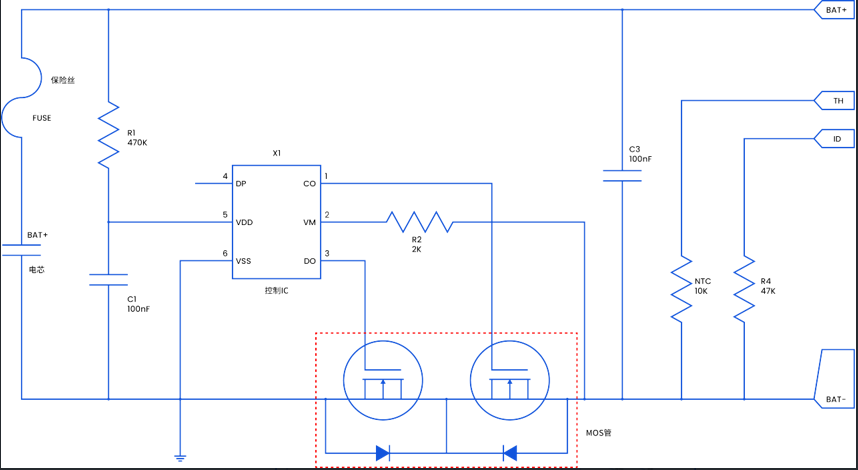
Block Diagram

Recommended Products
When designing computer notebooks, engineers should consider the following to ensure optimal performance and user experience:
Serial number
Product Model
Product Type
Data Sheet
1
Low-and Medium-Voltage MOSFETs
2
Low-and Medium-Voltage MOSFETs
3
Low-and Medium-Voltage MOSFETs
4
Low-and Medium-Voltage MOSFETs
5
Low-and Medium-Voltage MOSFETs
6
Low-and Medium-Voltage MOSFETs
7
Low-and Medium-Voltage MOSFETs
8
Low-and Medium-Voltage MOSFETs
9
Low-and Medium-Voltage MOSFETs
10
Low-and Medium-Voltage MOSFETs
11
Low-and Medium-Voltage MOSFETs
12
Low-and Medium-Voltage MOSFETs
13
Low-and Medium-Voltage MOSFETs
14
Low-and Medium-Voltage MOSFETs
15
Low-and Medium-Voltage MOSFETs
16
Low-and Medium-Voltage MOSFETs
17
Low-and Medium-Voltage MOSFETs
18
Low-and Medium-Voltage MOSFETs
19
Transient Voltage Suppression diode
20
Transient Voltage Suppression diode
21
Transient Voltage Suppression diode
22
Transient Voltage Suppression diode
23
Transient Voltage Suppression diode
24
Transient Voltage Suppression diode
25
Transient Voltage Suppression diode
26
Transient Voltage Suppression diode
27
Transient Voltage Suppression diode
28
Transient Voltage Suppression diode
29
Transient Voltage Suppression diode
30
Transient Voltage Suppression diode
31
Transient Voltage Suppression diode
32
Transient Voltage Suppression diode
pinpaimdd@mddchenda.com
+86 189 2606 7185